
Solowly
How can teams work together better?
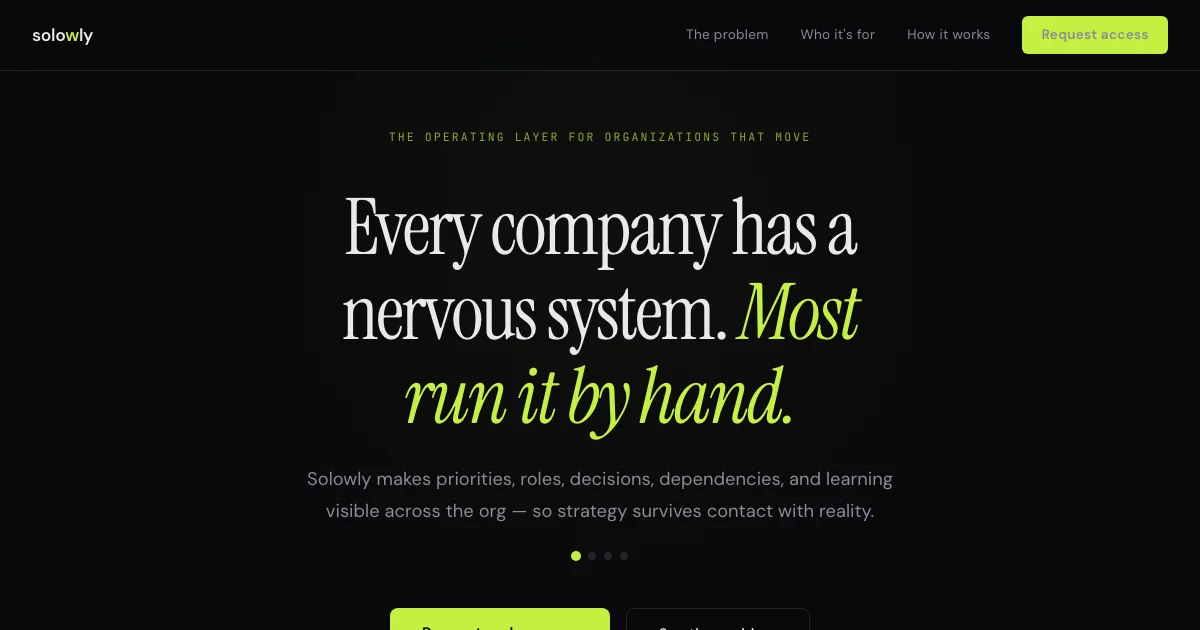
As organizations grow, coordination quietly starts to crowd out contribution. Decisions get relitigated, strategy drifts as it travels, and teams spend their best hours translating context to each other. Solowly makes the priorities, roles, decisions, and dependencies of a company visible in one living system, so shared understanding is explicit instead of constantly rebuilt by hand.
What is Solowly?
Solowly is an operating layer for organizations. It makes the things that usually live in people’s heads and scattered docs — priorities, roles, decisions, dependencies, and what the company is learning — visible in one place, and keeps them current as reality changes.
It is not another place to do work. It sits on top of the tools you already use — Slack, Jira, Notion, calendars — and works with whatever framework you already run, whether that is OKRs, GRREAT, or plain KPIs.
The Problem
Small teams coordinate by talking. Everyone shares the same context, so alignment is almost free. As the company grows, that stops scaling. The same decision gets relitigated in three rooms. Strategy morphs unrecognizably by the time it reaches the people executing it. Teams pull in slightly different directions because no one has the same picture, and someone is always manually translating context from one part of the org to another.
The result is that coordination starts to replace contribution. More meetings, more status updates, more management overhead, and less of the actual work the company exists to do.
The Idea
Make shared understanding explicit instead of implicit.
When priorities, decisions, and dependencies are written down in a system that stays live, strategy survives contact with reality. People can see how today’s work connects to where the company is going, decisions stop getting reopened, and context no longer has to be carried by hand from one team to the next.
The goal is to turn coordination overhead back into contribution — fewer recurring alignment meetings, less translation work, and clearer information at the moment a decision actually gets made.