
GRREAT
Is today's work actually moving me toward my goal?
Every serious undertaking starts the same way: a pile of half-formed thoughts that seem too obvious to structure and too tangled to act on. GRREAT walks them through stages (goals, research, roadmap, execution, analysis, time) and keeps asking 'have you actually thought about that?' until you have.
What is GRREAT?
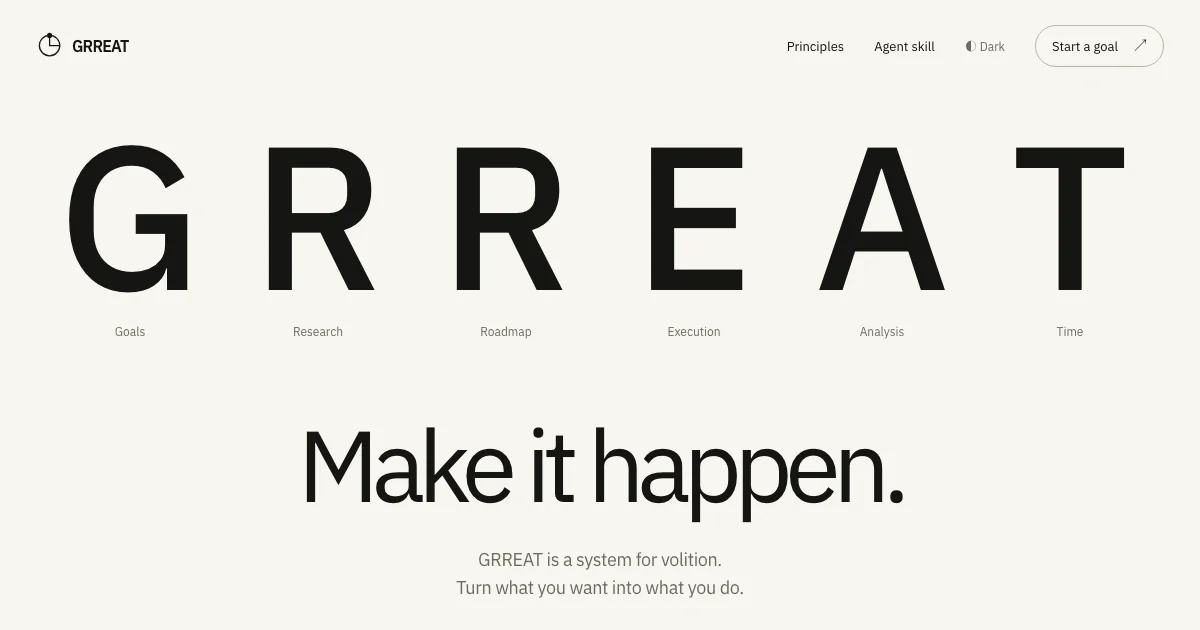
GRREAT is for people or teams who have a goal but need a clearer path from intention to action. It breaks the work into Goals, Research, Roadmap, Execution, Analysis, and Time so you can see how today’s activity is supposed to create tomorrow’s result.
The deeper idea is that a goal is not just a sentence and a todo list. A serious undertaking becomes a living model: what you want, what you do not want, what you know, what you are still deciding, what tradeoffs you have made, what assumptions are carrying the plan, what evidence changed your mind, and what can realistically happen next.
ELI5: it is a map that connects “what I want” to “what I should do next” and then checks if the map is working.
The Components
Goals — Outcome definition and boundaries. A goal becomes clearer through what it is and what it is not: desired futures, non-goals, anti-goals, constraints, tradeoffs made, and choices deliberately left open.
Research — Evidence base and option space. Research gathers relevant knowledge into a mind-map-style graph: concepts, sources, evidence, open questions, risks, options, stakeholders, contradictions, and relationships.
Roadmap — Program theory. The roadmap arranges the research graph into a purposeful theory of action: diagnosis, outcomes, intermediate outcomes, activities, assumptions, dependencies, checkpoints, bets, exit criteria, and what not to do yet.
Execution — Runtime planning. Execution turns roadmap checkpoints into concrete actions and queues. It helps when you hit a wall, breaks work down, changes owner when needed, parallelizes or delegates work, uses tools/templates/automation, and removes deliberation so you can enter runtime mode instead of re-deciding forever.
Analysis — Iteration. Analysis asks what the action taught and uses that evidence to improve the goal, research, roadmap, execution plan, or time estimate. This is where the system learns rather than merely records completion.
Time — Realism. Time turns todos into scheduled tasks and focus blocks. It estimates what can actually happen, accounts for capacity and switching costs, and updates projections based on what execution proves.
Thinking Tools and Purposeful Ontology
Each GRREAT stage should have thinking tools: prompts, canvases, checks, exercises, or workflows that fit the current kind of uncertainty.
Those tools do not just produce notes. When they work, they add to a self-assembled ontology for the undertaking: concepts, choices, constraints, assumptions, evidence, relationships, checkpoints, and tradeoffs. The orchestrator chooses a tool based on the current stage and need, then updates the model after a successful tool use.
In practice:
- Goals tools clarify desire, definition of done, non-goals, and tradeoffs.
- Research tools map the knowledge graph around the goal.
- Roadmap tools turn the research graph into program theory.
- Execution tools prepare runtime tasks, focus, leverage, delegation, and remove-deliberation defaults.
- Analysis tools decide what needs to change after evidence arrives.
- Time tools turn plans into realistic scheduled work and achievement projections.
Why This Framing?
Program theory is well-established in policy and organizational strategy but rarely applied to personal effectiveness. GRREAT adapts these concepts — logic models, theories of change, and outcome mapping — to individual use.
It is also intentionally unfinished in the right places. The canonical tool library and ontology schema are still being designed. The point of GRREAT is not to pretend the map is complete; it is to make the map improve every time reality answers back.